
Journal
·
6
min read
Why real-time visualisation helps sell luxury real estate
In premium real estate, showing a space is not enough: it has to be lived, understood and desired before it even exists.
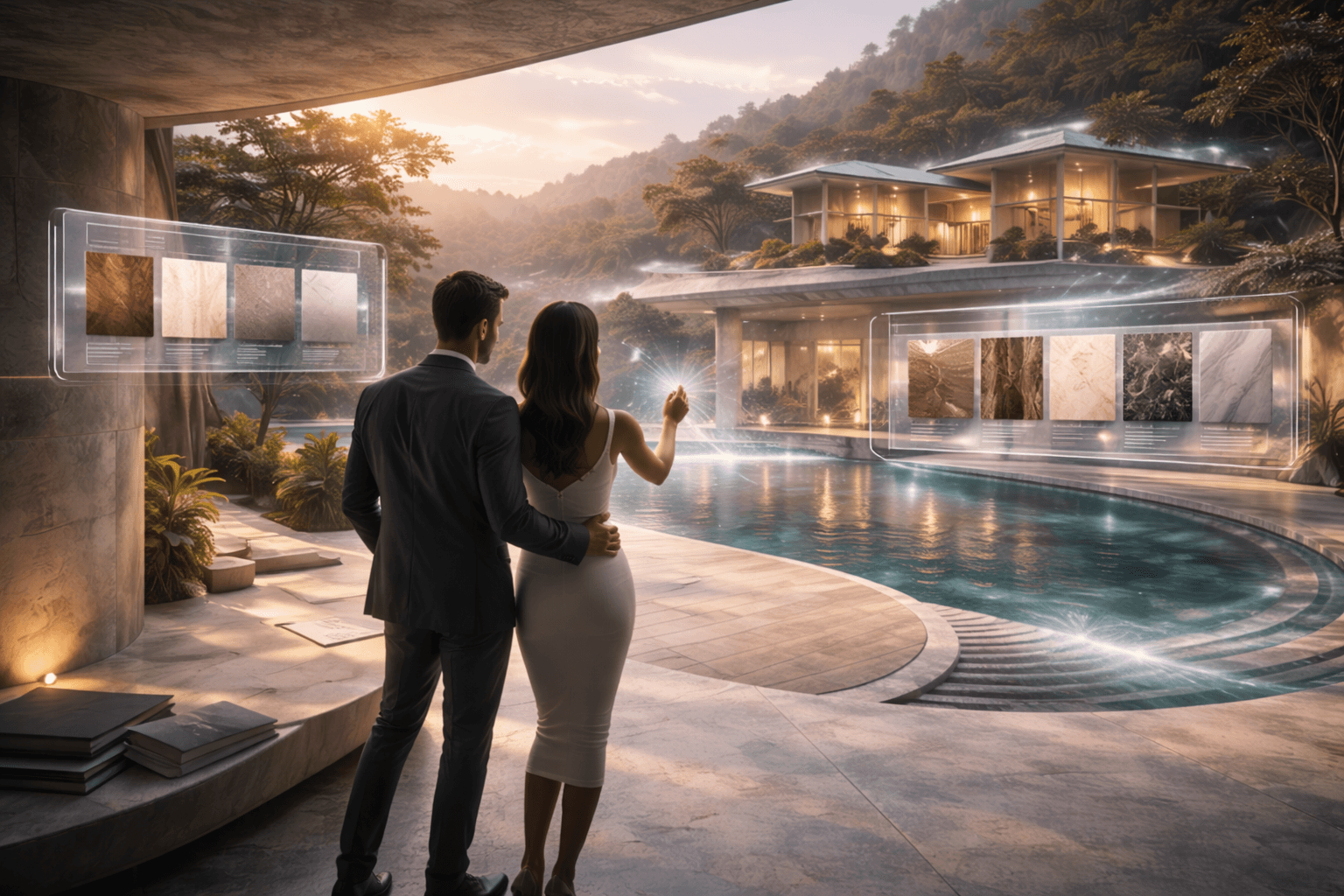
In the high-end property market, perceived value matters as much as real value.
A luxury property is not bought only for its location, its square metres or the quality of its finishes. It is bought for what it allows people to imagine. For the atmosphere it conveys. For the way a person can project themselves into that space and feel that it could truly be theirs.
This is exactly where visualisation plays a decisive role.
For years, static rendering has been the standard of property presentation. Photorealistic images, brochures, mood views, cinematic videos. All useful tools, but increasingly insufficient for a market that demands immediate engagement, quick understanding and the ability to decide in less time.
In premium real estate, especially for properties still to be built or customised, the real challenge is not only to show a project.
The real challenge is to make it real in the client’s mind.
Why luxury is sold first in perception
Someone buying a high-end property rarely buys “just” a home.
They buy a vision of themselves.
They buy a way of living, a future image, an idea of comfort, exclusivity and belonging.
That is why, in the premium segment, the sale does not happen only on a rational level. Above all, it happens on an emotional one.
A client can understand the quality of a marble, the value of a parquet floor or of a panoramic view. But what truly drives the decision is the ability to imagine themselves inside that space.
How will the light come in in the morning?
How will the atmosphere change in the evening?
How spacious will the living area feel?
How will the materials speak to each other?
How well will the space fit their way of life?
These are questions that a technical plan or a series of still images cannot always answer.
And when clients cannot truly imagine themselves in the space, the decision slows down.
The limit of still images
Static rendering has one great strength: it can be extremely evocative.
But it also has an obvious limit: it shows only what was decided in advance.
Each image represents a single frame, a single choice of materials, a single atmosphere, a single lighting condition.
This means that every doubt the client has requires new images, new versions, new revisions.
- “Can we see the living room with a darker parquet?”
- “I’d like to understand how the space changes with a different kitchen.”
- “Can you show me a brighter version?”
- “Can we try another wall finish?”
As soon as the client starts asking these questions, static rendering stops being a final tool and becomes a potentially endless process.
Every new request means time, waiting, new approvals and new costs.
Why real time changes the quality of the decision
Real-time visualisation changes this approach completely.
Instead of passively looking at a series of images, the client can step into the space, explore it, change materials, compare finishes, and check light and proportions in real time.
This does not only make the process more spectacular.
It makes it clearer.
Because the client no longer has to imagine what a variant might look like.
They can see it immediately.
This reduces doubts, revisions and decision times.
According to several reports on property marketing and proptech, immersive tools increase user engagement, improve lead quality and shorten the time needed to reach a decision. Virtual experiences help clients understand the product better and feel more confident in their choices, especially when the property is not yet complete.
In high-end real estate, where every detail counts and every customisation carries emotional weight, this difference can be decisive.
Selling before the property exists
One of the most important advantages of real-time visualisation is the ability to sell a property before it is even built.
For developers, investors and estate agencies, this means reducing uncertainty and speeding up the financial return of the project.
When a client can live a space before it is built, the distance between project and purchase shrinks.
The property stops being an abstract idea and becomes something tangible.
This matters most in off-plan projects, bespoke villas, luxury residential developments and every situation in which the client has to make decisions long before seeing the final result.
Many international firms already use immersive experiences for exactly this reason: they help pre-sell, customise and communicate the value of a project more effectively.
Customisation raises perceived value
In luxury, customisation is part of the value itself.
A premium client wants to feel that the space can adapt to their preferences, their materials, their taste, their idea of exclusivity.
Real-time visualisation makes all of this immediate.
Instead of describing a variant, you show it.
Instead of imagining another finish, you switch it on.
Instead of waiting days for a new version of the render, the decision is made the moment the doubt arises.
This does not only improve the client’s experience.
It also raises the perceived value of the whole project.
Because a space that can be explored, changed and understood conveys a much stronger sense of quality, innovation and control than a simple gallery of images.
Why emotional engagement is stronger
Immersion creates connection.
When a person virtually enters a space, walks through it, watches the light, observes the details and changes the materials, a far deeper level of engagement is triggered than a simple image can produce.
It is the same reason a real visit is more convincing than a brochure.
The difference is that today, thanks to real-time technology, this feeling can be brought forward long before construction.
And when clients already feel inside the space, the likelihood of an emotional bond grows.
In high-end real estate, this is essential.
Because luxury is not sold only by explaining it.
It is sold by letting people feel it.
The competitive edge for developers and studios
For an architecture studio, a developer or an estate agency, using real-time visualisation tools also means standing apart.
It means presenting yourself as more advanced, clearer, more transparent and more focused on the client’s experience.
It means:
- shorter decision times
- a better understanding of the project
- fewer revisions
- a faster sales phase
- greater client engagement
- a higher perceived quality of the brand and the property
In an increasingly competitive market, these elements can make the difference between a project that convinces and one that remains merely interesting.
The role of OMNI
With Signature, visualisation stops being a collection of separate images and becomes a single environment, explorable and customisable.
One space from which renders, videos, material comparisons, lighting studies and interactive experiences can all be created.
This lets the client do more than look at the project.
It lets them live it.
And it is precisely when a client begins to truly live a space that the sale stops being a simple negotiation and becomes an emotional, concrete and much faster choice.
Want to reduce revisions, misunderstandings and decision times on your next project?
Discover how Signature can transform the way you present, develop and approve a space with OMNI: Beyond Vision.
Giuseppe Baldo · Founder, OMNI