
Journal
·
4
min read
When a project stops being an image
For a long time, architectural projects were told through images. Accurate renderings, controlled views, framings designed to show a space at its best.
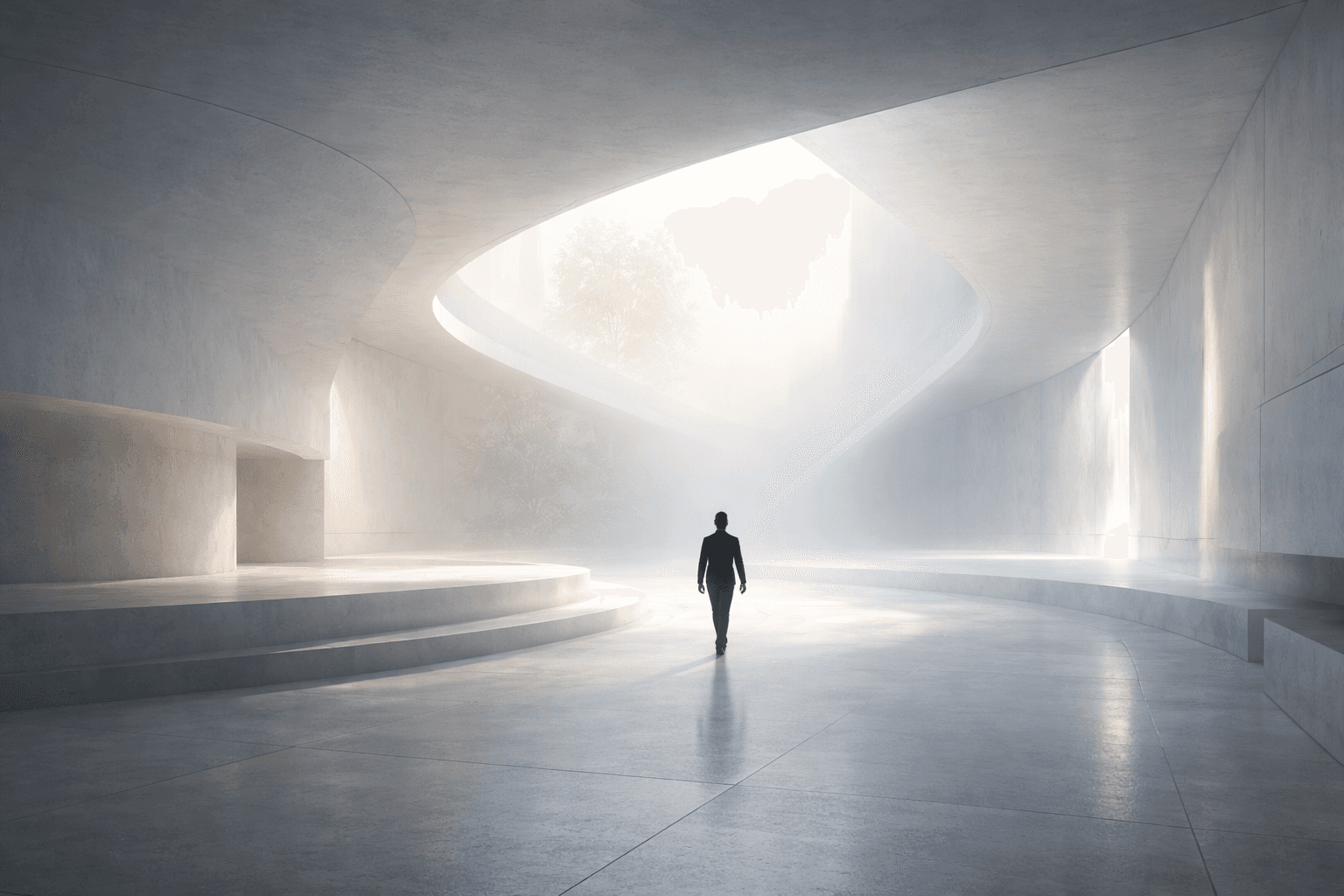
The image became the main tool for understanding, validating and deciding.
This approach worked as long as the project remained something to look at.
But looking at a space is not the same as understanding it.
There is a precise moment in the design process when the image stops being enough.
It is the moment when the questions change nature. They are no longer about how a space looks, but how it behaves. Not what it shows, but what it gives back over time, in movement, in presence.
That is the moment when a project stops being an image.
The image as a fixed point
An image is, by definition, a fixed point.
It freezes a condition, selects an instant, fixes a point of view.
In architecture this was, for years, a guarantee: the idea that a form could be evaluated, approved and understood through a stable representation. The image became a promise of control.
But space is not stable.
Space exists in time.
Light changes, proportions reveal themselves in movement, the relationships between rooms emerge only when you walk through them. None of this is easily captured in a single frame, however accurate.
The silent limit of representation
The limit of the image is not obvious.
It does not appear as an error, but as an absence.
A rendering can be correct, consistent, even convincing, and still fail to convey what makes a space truly legible. It can describe a form without describing the experience.
When design decisions rest only on still images, what gets evaluated is what is visible, not what can be walked through.
The decision is made on a fragment, not on the whole.
This is where a project risks closing too early, before its spatial implications have really been understood.
From showing to verifying
Moving beyond the image does not mean rejecting representation.
It means changing its role.
The image can keep telling the story of the project, but it can no longer be the only tool through which the project is validated. We need something that lets us verify, not just show.
When a space can be explored, seen from many points of view and questioned before it is defined, the project enters a different phase.
It is no longer a result to present, but an environment to test.
In this phase, value lies not in visual impact, but in the ability of the space to sustain the choices that shape it.
The project as an anticipated experience
Treating the project as an experience means accepting that a space is understood before it is built.
Not as a simulation for its own sake, but as a critical tool.
An anticipated experience captures what drawings and images cannot fully convey: real scale, continuity, the relationship between the body and the space.
When architecture is approached this way, decisions carry a different weight.
They are no longer the result of a visual conviction, but of a direct relationship with the space, even while it is still hypothetical.
A shift in responsibility
This shift is not only about tools, but about the responsibility of the project.
Deciding after having lived in a space, even partially, is different from deciding after having looked at it.
It means taking on the weight of the spatial consequences of each choice, not only the formal ones.
It means accepting that a project is not resolved all at once, but understood step by step.
In this sense, experience does not simplify the process.
It makes it more aware.
When the image is no longer enough
The moment a project stops being an image is not a technological moment.
It is a methodological one.
It is the point at which it becomes clear that looking is no longer enough, that deciding requires presence, and that space asks to be questioned before it is fixed.
OMNI: Beyond Vision was born exactly in this passage.
At the point where a project stops being something to look at and becomes something to enter into a relationship with.
Not as a spectacular gesture, but as a choice of method.
An open question
If a project is no longer an image to approve, but an experience to understand, then the process itself has to change.
It can no longer move forward through final representations alone; it has to open up to continuous forms of verification.
This is where the next question opens, perhaps the most relevant one:
what happens when, during the design process, the space begins to respond to the decisions that shape it?
Giuseppe Baldo · Founder, OMNI